The Hidden Sector
The Standard Model (SM) of particle physics is a very successful theory describing the fundamental particles and their interactions. However, it is known to be incomplete, as it does not explain several phenomena observed, such as Dark Matter, the baryon asymmetry in the universe and the non-zero masses of neutrinos. These observations suggest that there may be unexplored particles and interactions beyond the SM, which are referred to as the "Hidden Sector".
The SHiP Experiment is a proposed beam dump experiment and detector at the SPS North Area, designend to search for weakly interacting particles like Heavy Neutral Leptons (HNLs), Dark Photons, Axion-Like Particles (ALPs) and other long-lived particles with masses in the MeV to GeV range. The SM can be extended by so-called "portals", which enable interactions of the proposed particles with the SM and are offering the best chances to detect new physics at the moment. Since the lifetime of these particles is expected to be long, their decay length exceeds the size of existing detectors in high-energy collider experiments, making it challenging to detect them.
With its design, SHiP aims to probe large areas in the unexplored phase space and detect "Feebly interacting Particles" (FIPs) by finding their decay products in a dedicated detector. Using a beam dump facility to generate HNL candidates, the experiment creates an environment where only FIPs, Neutrinos and a small amount of Muons can reach the detector, thus creating an optimal environment to detect the decay of a HNL.
Heavy Neutral Leptons (HNLs)
Along all candidates for FIPs, Heavy Neutral Leptons (HNLs) are the most promising candidates. HNLs are introduces as sterile right-handed neutrinos that do not participate in Standard Model gauge interactions directly. Through their mixing with active neutrinos, they acquire suppressed weak interactions. A minimal extension to the Lagrangian of the SM, the "seesaw extension", is given by the following Lagrangian for the "Type I seesaw mechanism":
with the parameters for the HNL Mass \(M_N\) and the mixing \(U_{\alpha I}\) with the SM neutrinos, which are expected to be in the following range:
The HNLs can mix with the SM neutrinos, leading to a small but non-zero mass for the SM neutrinos through the "seesaw mechanism". It is expected that HNLs can be produced in the decays of heavy mesons, such as \(D\) and \(B\) mesons. These decays can either be fully leptonic:
or semi-leptonic:
where \(l^\pm\) are charged leptons (electrons or muons) and \(N\) is the HNL. For HNLs with masses below \(\lt 2\,\text{GeV}\) the decay of the D meson is the dominant production channel. While for HNLs with masses above \(\gt 2\,\text{GeV}\) the decay of the B meson is the dominant production channel, the SHiP Experiment does not rely on this channel.
The HNLs can then decay into SM particles, such as charged leptons and neutrinos, which can afterwards be detected as displaced vertices in the SHiP detector. The possible decay channels for HNLs are:
HNLs are interesting candidates to probe for, because they can explain the small neutrino mass and the barion asymmetry by proving evidence for sterile neutrinos and test parameter regions motivated by the seesaw mechanism. The SHiP experiment will explore the HNL parameter space in the mass range of \(0.5\,\text{GeV}\) to \(5\,\text{GeV}\) and mixing angles down to \(|U_{\alpha I}|^2 \sim 10^{-10}\). Fig. 1 shows the sensitivity curve of the SHiP experiment for HNLs. The excluded parameter space from other experiments as well as the Cosmic Microwave Background (CMB) and Big Bang Nucleosynthesis (BBN) constraints are also shown, as well as the "seesaw type 1" limit region, approximately covering the theoretically predicted region for HNLs to explain the observed light neutrino masses. The solid blue curve is the parameter space, SHiP is expected to cover within 15 years of operation at \(90\%\) confidence level. The dashed blue curve is the parameter space, SHiP is expected to cover within its first year.
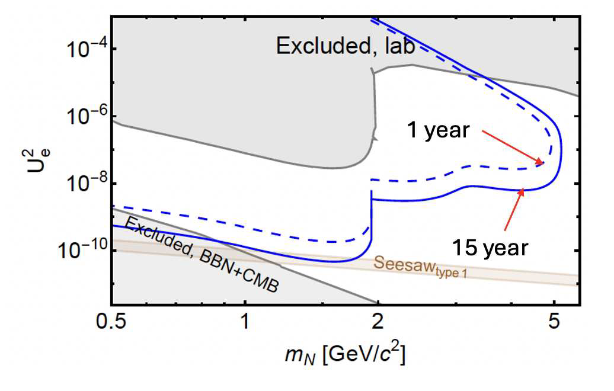
Fig. 1: The sensitivity curve of the SHiP experiment for Heavy Neutral Leptons (HNLs)1. The experiment covers a mass range from \(0.5\,\text{GeV}\) to \(5\,\text{GeV}\) and mixing angles down to \(|U_{\alpha I}|^2 \sim 10^{-10}\). The excluded parameter space from other experiments as well as the Cosmic Microwave Background (CMB) and Big Bang Nucleosynthesis (BBN) constraints are also shown, as well as the "seesaw type 1" limit region. The solid blue curve is the parameter space, SHiP is expected to cover within 15 years of operation at \(90\%\) confidence level. The dashed blue curve is the parameter space, SHiP is expected to cover within its first year.